Sarah K. Whitfield is a music and theatre researcher, dramaturg, writer and digital humanities scholar. Her research focuses on exploring the historiography of music and theatre, and recovering the work that women and minoritised groups have done through archival research and digital humanities. She has published widely on collaborative practice in musical theatre, film musicals, and in queer fan studies. Her most recent books are the edited collection Reframing the Musical: Race, Culture and Identity (2019), and An Inconvenient Black History of British Musical Theatre 1900-1950, co-written with Sean Mayes.
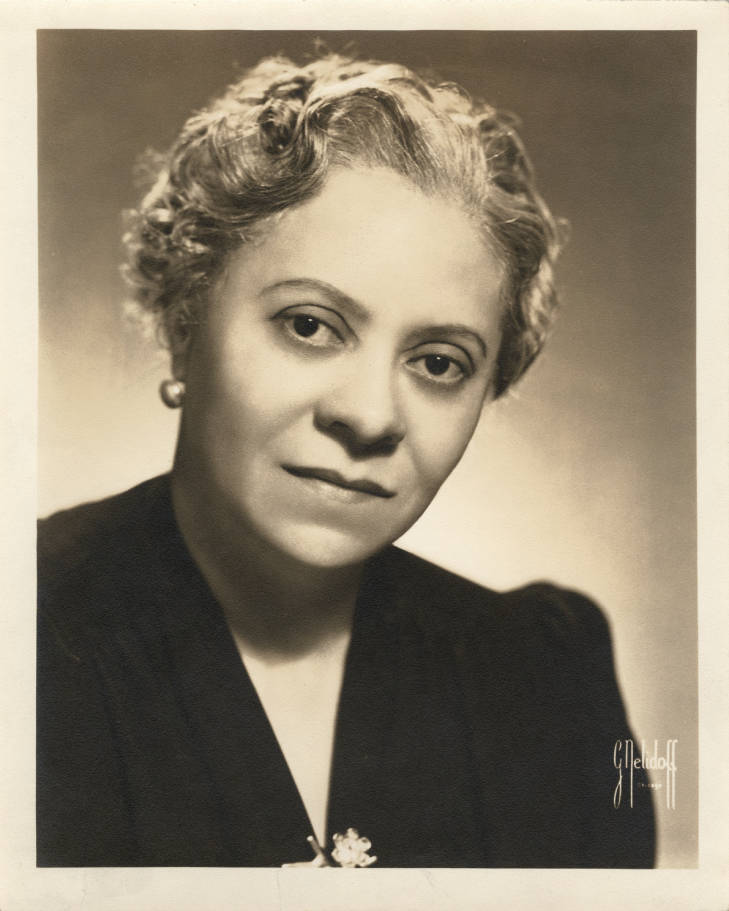
Clare Kummer had a song which was a huge hit: “Dearie” in 1905, which sold over 1 million copies of sheet music. To put that in context: in 1900, it is estimated that there were about 1 million pianos in the entire US.
Cissie Loftus, after being asked why there’s no International Men’s Day
It’s been a little while since I last used this lovely site, leaving the delights of Simba the Not the Lion King up as my final statement, which clearly has to change! Lots to discuss, but most recently I’ve written a series of blog posts which started yesterday for Maestra on women composers who were part of Broadway’s early history. The first went up on #Internationalwomensday – and features the work of Cissie Loftus.
As well as showcasing my stalker/detective/historian skills, it represents the first time her compositions have been listed in one place. In time – it means that it can be used to improve her Wikipedia page – and particularly for Nora Bayes, who doesn’t even have one yet!
To start off, I’ll explore the work of three of the most prolific women composers in early 20th century musical theatre: Clare Kummer, Cecilia ‘Cissie’ Loftus, and Nora Bayes. They all worked at the beginning of the 20th century and all took on multiple roles in their professional careers, including: acting, music hall performance, composition, lyric-writing, and producing. The three women attracted extensive press coverage, not least because all three of them disobeyed expected social mores in their personal lives: Bayes had five husbands and Loftus’s divorce made international headlines. Yet their composition practice has largely been forgotten. Retracing their work is one way of changing that.
Maestra Music is an incredible organisation, working to support women composers and music professionals in musical theatre, led by Georgia Stitt. Next week will be Nora Bayes and the week after Clare Kummer, so stay tuned and sorry for leaving off-brand Simba for so long, all by himself.
Technically it’s a Sunday. I see that. But here we have part 2 of Just Another Love Story – and we move into the 1980s and the AIDs crisis in New York. If it all goes a bit wobbly on mobile devices – you can download it here sondheim comic 2.
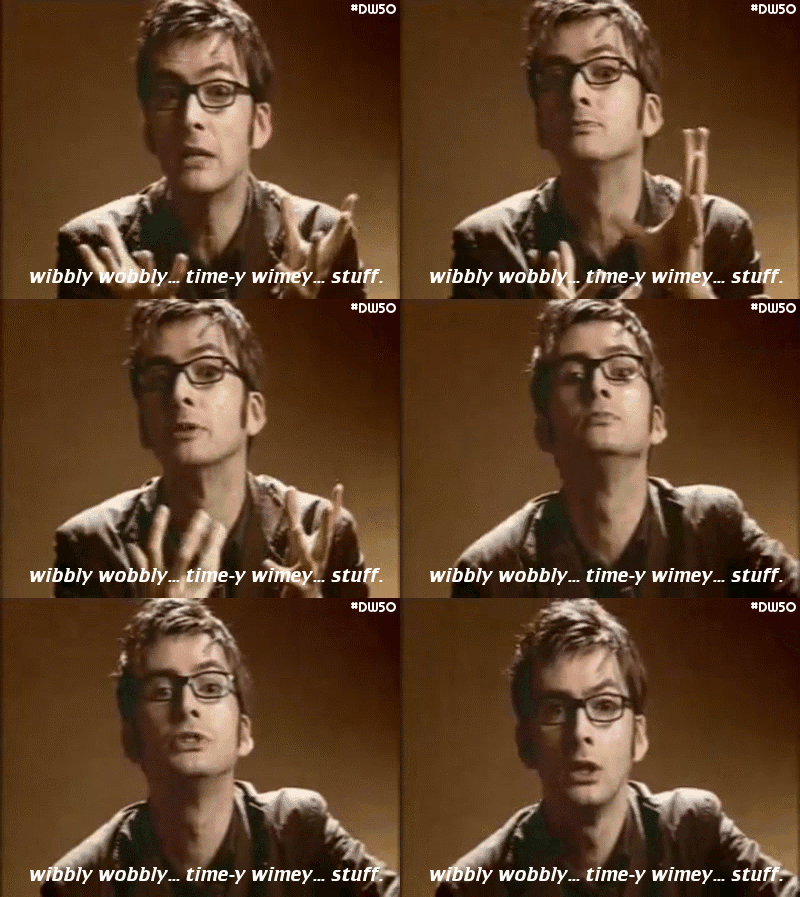
So in last week’s Saturday Sondheim: I looked at the idea of knowing things, and what the cost of that is for the characters who learn things but pretty much always have to deal with the ambivalence that leads to. This week – I want to go slightly further into the nerdy academic looking glass of how Sondheim sometimes messes with time. If you thought you were not going to get a Doctor Who reference here then I’m sorry, I’m so so sorry.
If I’m going to invent blog post series for myself to write about, then getting to talk about Crazy Ex-Girlfriend is a serious perk. I’ve been wanting to do a nerdy take on dramaturgy in this show for a while, so let’s go. I’m going to start with a song and it’s reprise – ‘The New Guy’, as it’s a) ridiculous and b) delightful.
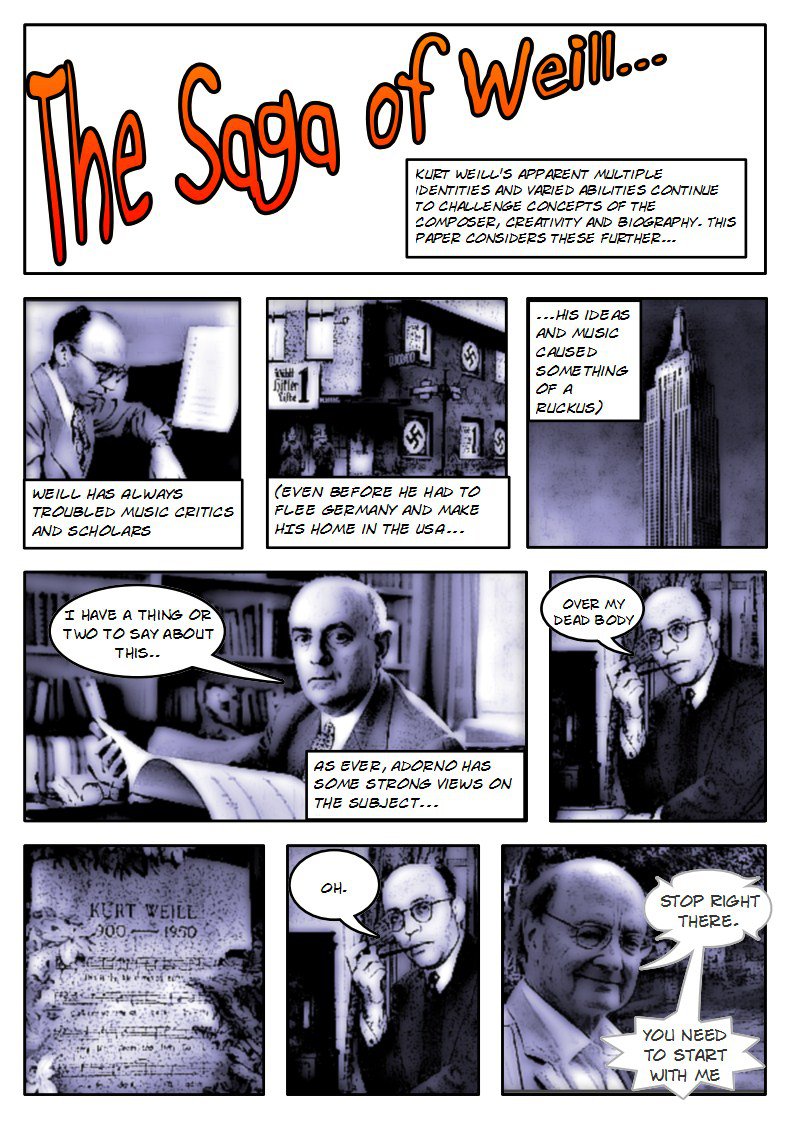
Many moons ago – so long ago I can’t actually remember what the software was that I did it on – I got so stuck trying to write an academic paper that I tried a new way of writing the thing. Eventually (twins, and some years later) it became this: ‘Next you’re Franklin Shepard Inc.?’: Composing the Broadway musical, a study of Kurt Weill’s working practices published in Studies in Musical Theatre in 2017. I am still quite taken with it – because it forced me to distill my ideas into a very clear format.
Over the next few weeks, I’m going to explore some of the key themes in Sondheim songs and address the ways in which Sondheim returns to certain ideas or dramatic plot points. It might help to know that I’m primarily a dramatist, so I’m going to be looking at the work in that way first rather than the music. This week we’re looking at five songs from Into the Woods, Company, Merrily We Roll Along, Passion and Follies.