
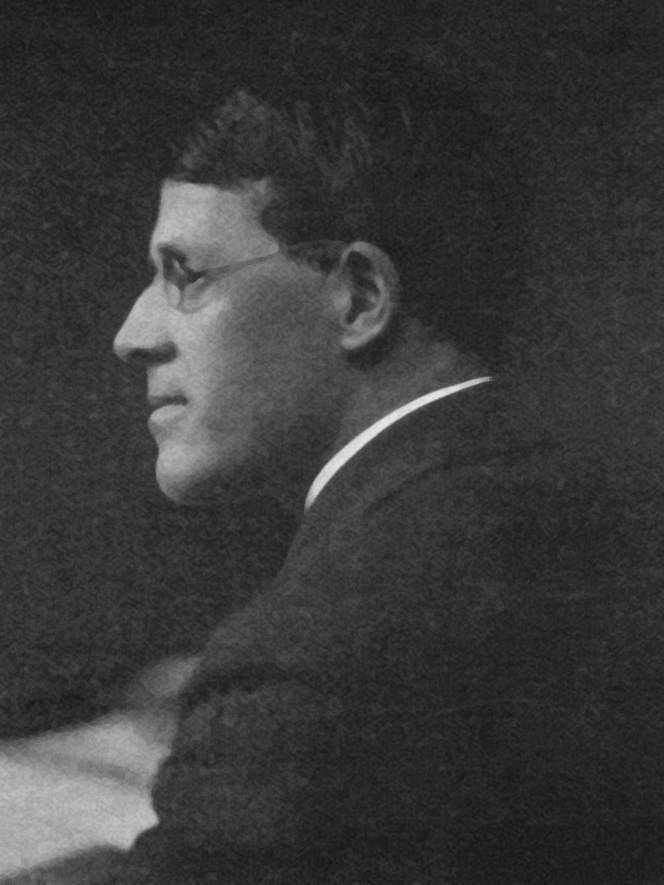
Thomas Appleby Matthews (1884-1949) is a surprisingly unknown figure given his importance to music making in Birmingham. He was the first conductor of what became the City of Birmingham Symphony Orchestra – then the City of Birmingham Orchestra.
He does have a Wikipedia article to his name, but no article in Grove Music (Oxford Music Online) – though he gets a mention in their article on Birmingham’s music history. I’ve been drawn into his story because of the commitment he had to put classical music where people already were – in local cinemas and theatres.
He was from the West Midlands, born in Tamworth, he studied music at Birmingham’s Midland Institute School of Music (which would eventually become the Royal Birmingham Conservatoire). During his 20s, he appears in various newspaper articles running be found in various small gigs, as accompanist and choir director, for example in 1906 he conducted the choral society at Alcester, and as organist for Oldbury Parish Church. By the end of the 1900s he became assistant organist at Birmingham Cathedral.
But it was what happened during the next decade that tied his story to Birmingham. He began developing choirs and eventually orchestras to perform in the city. In 1913 he advertises for ‘additional voices’ – ‘basses, not baritones’ for ‘The Birmingham Select Choir and Madrigal Society’, though the choir was unsuccessful owing to a lack of men. The intention was to perform in theatre spaces, like Birmingham’s now demolished 1,200 seat Grand Theatre – as well as the Botanical Garden.
During World War 1, Matthews conducted two premieres of parts of Elgar’s ‘Spirit of England’ triology, ‘To Women’, and ‘For the Fallen’, having previously trained the choir. The sense that these concerts were offering moral support and sustenance to a city facing the loss of many of its young men, is clear in the coverage. Matthews conducted St Matthew’s Passion at the Repertory Theatre over Easter in 1917, with Gervase Elwes as soloist. There was clearly an attempt to draw a wide audience to these events – sometimes concertgoers were allowed to smoke, and he also arranged concerts at cinemas like the Scala Theatre.
Matthews later recalled a concert he gave at the Scala Theatre ‘We were giving the Creation when suddenly the electricity failed. Makeshift illumination was provided by candles, and we carrie don. Then suddenly just as the words ‘Let there by light’ were reached on came the electric lights. it was an amazing coincidence, and brought the house down.’
He set up weekly concerts again at the Rep in 1918 – the first was given by Myra Hess who so memorably performed in London during World War 2. Matthews also had an enduring association with the City of Birmingham Police Band – regularly conducting them and using their rehearsal space Many contemporary composers were featured in his theatre concerts or those at the Midland Institute, for example Eugene Goossens’ ‘Five Impressions of a Holiday‘, some of Debussy’s work, and John Ireland.
It was on 19 June 1919 that the official City of Birmingham Orchestra was founded – who would become the City of Birmingham Symphony Orchestra – with the guarantee of £1,250 put up by Birmingham council. They didn’t start playing though until the 1920-21 season, when they began regular concerts at which Sibelius conducted his own work – the ever popular ‘Finlandia’. In April 1920, Matthews announced his plans for the year – 48 concerts in total. The council asked Matthews ‘to prepare and submit to the committee a scheme for giving orchestral concerts in the courts and alleys of the slum areas.’ It’s unclear whether he ever did this – but it’s worth noting the intention of the orchestra was to be heard by everyone in the city.
For his work during the proceeding decade, and in founding the orchestra, in February 1921, Matthews was awarded the Birmingham Civic Society’s first ever gold medal for his contribution to the musical life of the city. Shortly afterwards Matthews had to announce the orchestra had made a loss of £2,000 in its first year. He was not long in post, and By March 1924, Matthews was given his notice from the orchestra and later won a rather protracted legal battle with the Council for one month’s notice of £54. Adrian Boult succeeded him in the post.
Reflecting back on his career and his success in expanding musical provision in Birmingham, Matthews noted that ‘Of course it could never have been done had not the ordinary Birmingham man in the street been a music lover. His is the credit.’ Matthews

 Sarah Whitfield