
As should by this point be becoming clearer, I like a wild goose chase. In this case, a very short Wikipedia article on Harriet Maitland Young (1838-1923) got my attention, a composer about whom very little is known other than her mention in the Women’s Work in Music (1903). The Wikipedia article lists four operettas by Young, and notes she is buried in Camden. So if we dig a bit more… what do we find? I think you’ll know by now I can’t resist a mystery adventure.
So British Newspaper Archive turns up a mixture of results, more for Harriet Young than with Maitland. This is going to be a problem, so we’ll be relying on a second search term to really have much luck. Because Harriet Young is a fairly common name, ‘Harriet Young’ and ‘composer’ is one of the only ways in. That takes us to the occasionally well-intentioned, if patronising description that she was ‘a composer of some of the prettiest songs of the day’ (Illustrated Sporting and Dramatic News). Thankfully that article also has at least a drawing of her, the only image I have been able to find.
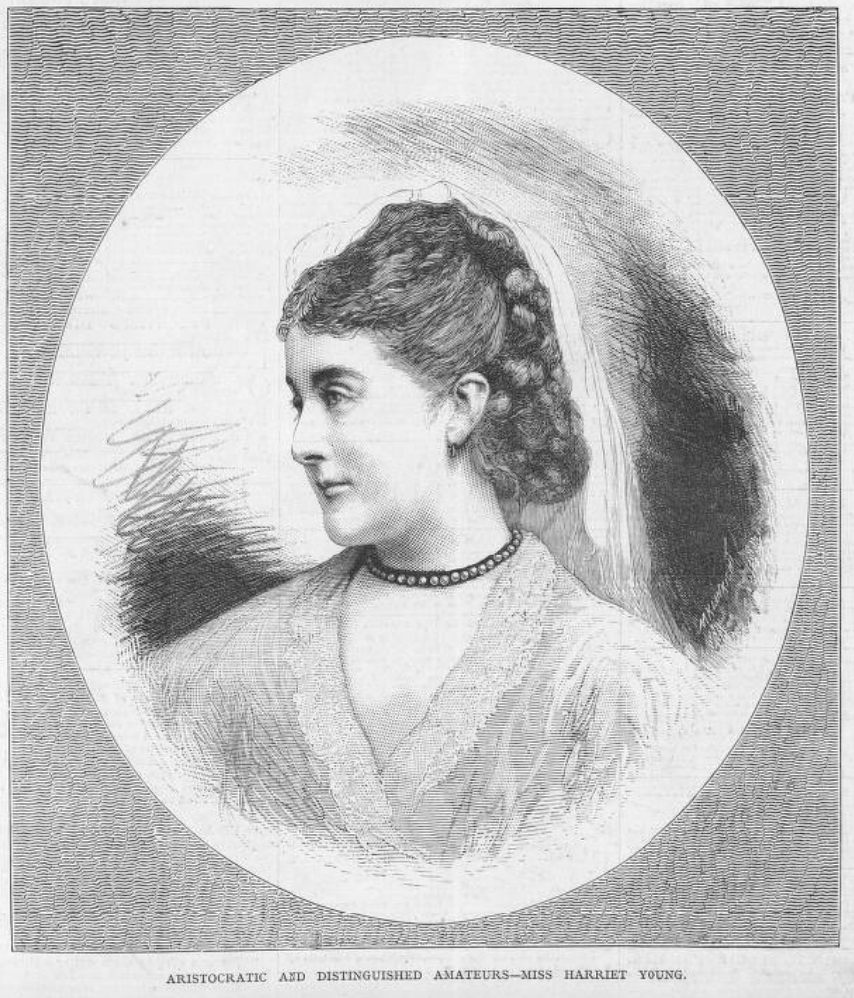
Searching for Young eventually reveals a pianist composer who was part of two musical worlds of amateur and semi professional music making, one in Brighton and the South Coast, and the other in London. She wrote several operettas that were apparently specifically written for small casts to suit amateur performances.
She herself was an actor in such small productions, one was even described as a ‘drawing room operetta’, in the 1870s. Her performance career clearly gave her a detailed knowledge of what worked in these settings, as one review noted: ‘Miss Young is a disciple of the true comic opera school, and knowing the stage as well as the piano, gives us music which is dramatic as well as musical’ Illustrated Sporting and Dramatic News, 8 February 1879, 14.
As ever, trying to retrace a ‘works by’ list is a job in itself. Since this has turns up some new work I’ve produced a new list here. These operettas seem to have played as one acts pieces in concert evenings.
- The Queen of Hearts (1877) premiered at Brighton’s Royal Pavilion
- Breaking the Ice (1880) performed at Kingston Assembly Rooms, premiere unclear.
- An Artist’s Proof (1882) premiered at Brighton’s Pavilion
- When One Door Shuts Another Opens (1885) premiered at the Town Hall, Hove
- The Magic Glass (1887) premiered again at the Town Hall in Hove
- Tobacco Jars (1891) performed at Lyric Hall, Ealing, premiere unclear, libretto by Lady Monckton
- A Fighting Frenchman (1895) premiered at Hasting’s Pier
- The Holly Branch (1895) an operetta for two people, premiered at Lowestoft Pier
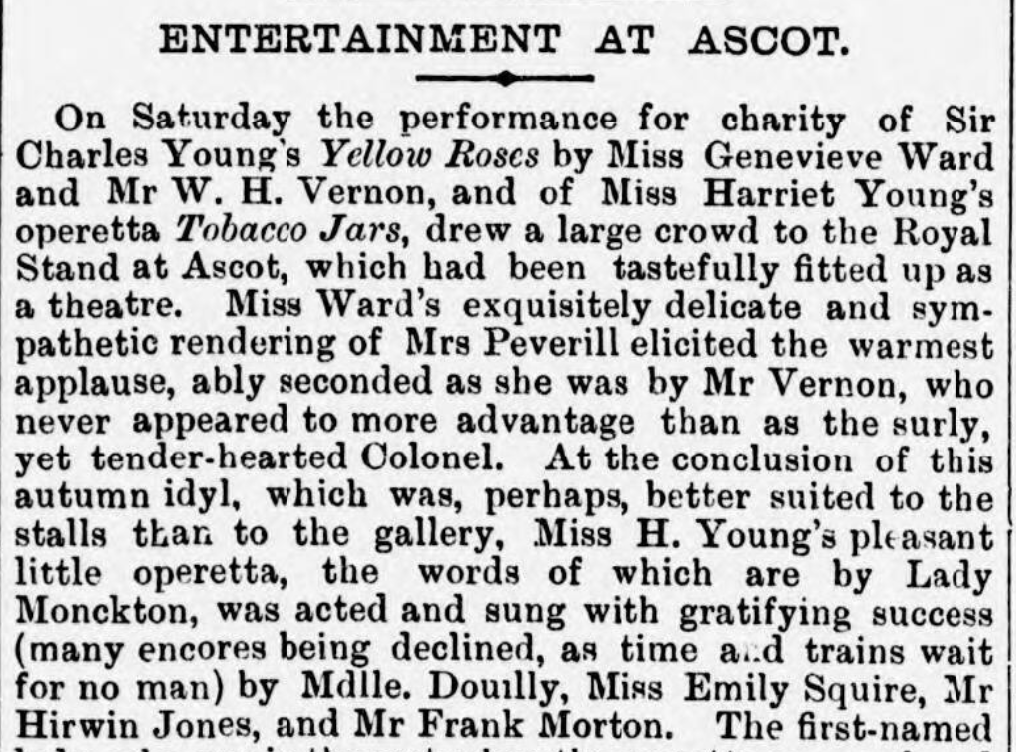
The curiously named Tobacco Jars was not entirely well received, one review noted that ‘[her] music is rather commonplace and hardly up to the level of the libretto’ The Scotsman, 13 June 1889, 5. Yet it was certainly performed, here somewhat curiously at Ascot in December.
She did have a London connection, and seems to have moved between the two settings. For example in 1894 Young accompanied for a performance of her song at one concert, a curiously named ‘at-home‘ held in Brinsmead’s Galleries (a piano showroom), that could perhaps be best described as aristocracy adjacent with the presence of Lady Colin Campbell (Gertrude Blood, a woman dragged through a horrendously public divorce scandal, if you fancy getting lost in Wikipedia).
Songs
Around 30 of her works are listed in the British Library catalogue, with song titles that suggest romantic songs aimed at domestic performances, such as ‘Roses Red and Roses White’ and ‘The Birth of Love’. Having said that, since the scores don’t seem to exist for her operettas, they may have been taken from the longer pieces.
One short duet, ‘In Sunny Spain’, was described as ‘easy to learn and pleasant to sing’ by The Graphic. The incredibly named Myra’s Journal of Dress and Fashion described another of her songs as a good ‘drawing room’ song, ‘of no great difficulty for mezzo soprano and soprano voices’. Many similar descriptions politely gesture at the skill required, another song of hers ‘Tell Me Dearest’ is described as ‘an unpretentious ballad for a voice of medium compass’, again in The Graphic.
As much as we could assume that women were expected to be writing this kind of commercial music, plenty of men were also producing similarly named songs for domestic audience. And that there is skill in writing playable and singable music. In addition – in many articles of the period that are tasked with introducing this month’s new sheet music, say, the composer’s gender is simply not mentioned beyond naming her:
An extremely simply but pretty song for soprano is ‘Bright Days of my Childhood’, words by Mrs Pitt Draffen, music by John Thomas. Tenors who desire a cheerful and melodious love song may be recommended to try ‘A Passing Cloud’ by Harriet Young. Weekly Dispatch (London), 28 December 1884, 6
I couldn’t really find any more on this particular trail, Harriet Young is too common a name to turn up anything useful in genealogy websites, so there’s not much more to go on. But an evening of looking found several new works, the idea of small scale operettas which I’d certainly not come across before, and another example of a woman finding a way to make a living in music from performance and composition.

 Sarah Whitfield